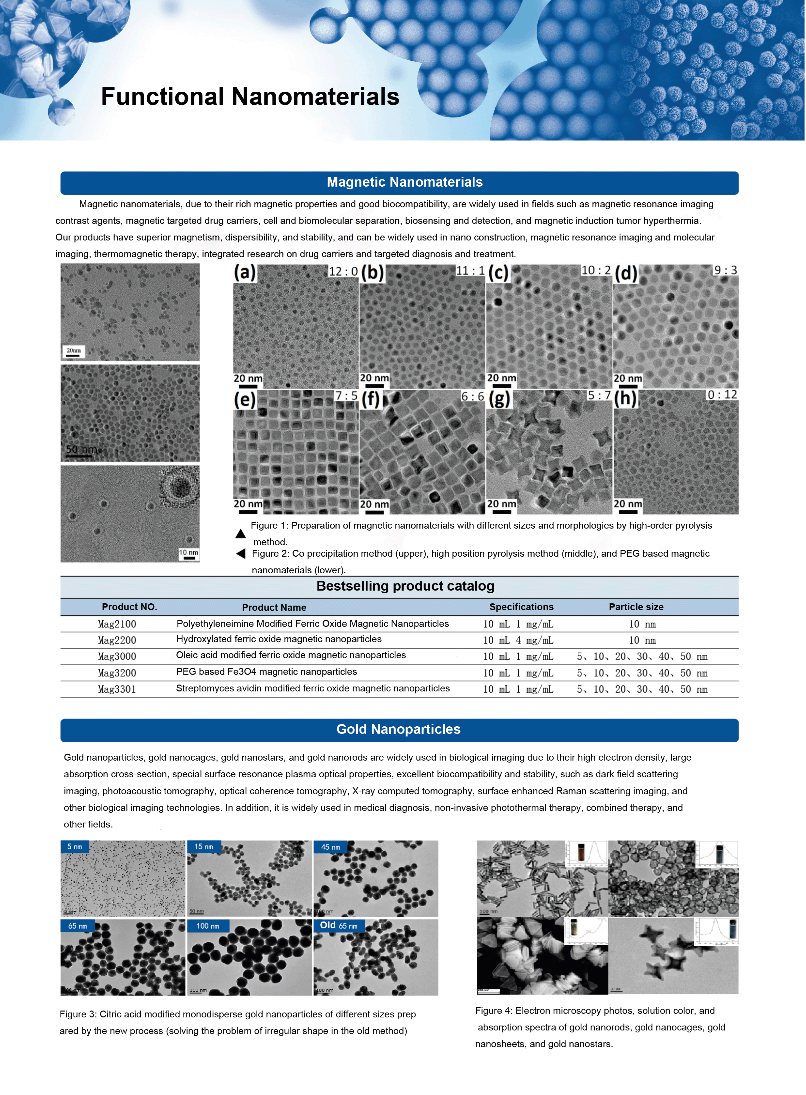
1.Magnetic nanomaterials (mainly granular materials such as Fe3O4 and g-Fe2O3 nanoparticles) have extensive applications in biomedical fields such as magnetic resonance imaging contrast agents, magnetic targeted drug carriers, cell and biomolecular separation, biosensing and detection, and magnetic induction tumor hyperthermia due to their rich magnetic properties and good biocompatibility.
Our magnetic nanoparticles have excellent magnetism, dispersibility, and stability, and can be widely used in the construction of nanoprobes, magnetic resonance imaging and molecular imaging, magnetic hyperthermia, drug carriers, and integrated research on targeted diagnosis and treatment.
2. Gold nanomaterials
Gold nanoparticles, gold nanocages, gold nanostars, and anisotropic gold nanorods are widely used in biological imaging due to their high electron density, large absorption cross-section, special surface plasmon resonance optical properties, excellent biocompatibility and chemical stability, such as dark field scattering imaging, photoacoustic tomography, optical coherence tomography, X-ray computed tomography, etc Surface enhanced Raman scattering imaging and other biological imaging technologies. In addition, gold nanomaterials are also widely used in medical diagnosis, non-invasive photothermal therapy, combined therapy, and other fields. Provide high-quality gold nanomaterials, including gold nanoparticles, gold nanorods, gold nanocages, gold nanotriangles, etc. At the same time, Dongna Bio can also provide oil soluble and PEG gold nanomaterials to meet the different experimental needs of scientific researchers.
3. Silver nanomaterials
Silver nanomaterials, due to their excellent surface plasmon resonance (SPR) properties, have been widely studied and applied in various fields such as catalysis, biological and chemical sensing, nonlinear optics, surface enhanced Raman scattering, cytotoxicity, antibacterial testing, radiation sensitization, dark field imaging, electronics, and more.
4. Silicon nanomaterials
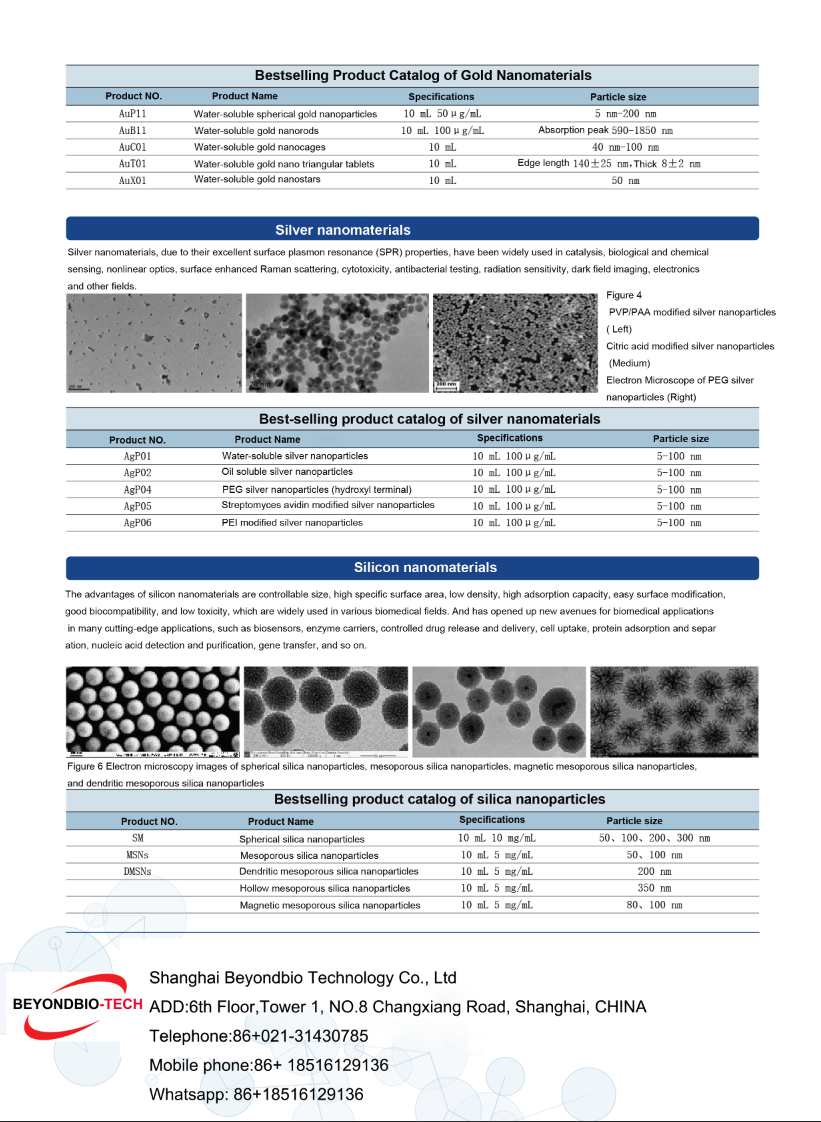
Silicon based nanomaterials are widely used in various biomedical fields due to their controllable size, high specific surface area, low density, high adsorption capacity, easy surface modification, good biocompatibility, and low toxicity. They have opened up new avenues for biomedical research in many cutting-edge applications, such as biosensors, enzyme carriers, controlled drug release and delivery, cell uptake, protein adsorption and separation, nucleic acid detection and purification In terms of gene transmission. Provide high-quality monodisperse silicon nanomaterials, including silica nanoparticles, mesoporous silica nanoparticles, dendritic mesoporous silica nanoparticles, hollow mesoporous silica nanoparticles, magnetic mesoporous silica nanoparticles, etc., to meet the diverse experimental needs of scientific researchers.