The 30010 Dry Powder Insufflator is a hand-operated, pulmonary drug delivery device.
It is designed to produce a cloud of fine particles from the end of a small-diameter delivery tube.It can be used to aerosolize and administer a precise dose of dry powder to the lungs, nasal cavities or other invitro applications. Dry Powder Insufflator has also been used for analysis, testing and development of dry powders. It has a hollow stainless steel tip with a 120-degree bend that helps keep the user’s hand out of the line of sight, making it easier to view the epiglottis. The atomization transmission module of this device is sterilizable and reusable.
1. Introduction
Dry Powder Insufflator Model 30010 specifications:
- ·Based on stainless steel, thin-wall needle tubing with an outer diameter (o.d.) of 1.00mm
- ·Single atomization powder mass: 1-10 mg(if the Sample density =1)
- ·Single aerosol generation:0.5-5ml
- ·Particle size: More than 90% of particle under 5 microns (ISO12103A2 sample test)
2. Dry Powder Insufflator--Application
Dry Powder Insufflator can be used in many fields, such as inhalation toxicology, aerobiology, biological hazard testing, inhalation immunity, inhalation therapy, drug research, environmental research, environmental assessment, biological, chemical hazard assessment and medical protection.
a. Investigation of pulmonary absorption mechanisms
By administering labeled dry powder drugs, the absorption and transport processes of the drug in alveoli and pulmonary interstitium can be observed, and the absorption rates and extent of drug uptake at different sites such as alveoli and pulmonary interstitium can be accurately determined, thereby establishing a reliable drug absorption model.
b. Analysis of pulmonary metabolic processes
The pulmonary dry powder administration technique enables the detection of drug metabolite formation and changes in the lungs post-administration, facilitating analysis of pulmonary metabolic enzyme activity and metabolic pathways. It also allows assessment of pharmacokinetic parameters in the lungs, including metabolic rates, metabolite formation, and clearance.
c. Assessment of pulmonary clearance mechanisms
Dry powder administration to the lungs can act directly on pulmonary tissues, and studies have investigated the effects of alveolar macrophages, pulmonary surfactant, and ciliary motility on drug clearance.
d. Investigate pulmonary immune responses and barrier functions
By administering pulmonary dry powder containing immune stimulants, the activation of pulmonary immune cells and inflammatory responses can be observed. The use of labeled particles or macromolecules as probes enables evaluation of the regulatory role of barrier structures such as pulmonary vascular endothelium and epithelium in substance permeability.
e. Establish a pharmacokinetic model for pulmonary-systemic circulationBased on pulmonary dry powder administration data, a detailed pharmacokinetic model of the lung-plasma-systemic circulation can be established to more accurately predict the drug's absorption, distribution, metabolism, and elimination processes in vivo.
3. Other Product RecommendationsThe appropriate tools can significantly enhance your workflowefficiency. The endotracheal intubation table and smallanimal larngoscope serveas essential aids for performing pulmonary drug administration procedures, and are recommended to be used in conjunction with a pulmonary dry powder nebulizer.
a. Tracheal Intubation PlatformThis sytem supports small animals such as mice and rats in maintaining a stable and comfortable position for tracheal intubation, drug perfusion, and other similar experinental procedures. t alows fixation at various puncture sites as required and enables adustment of mutiple operational angles to meet the demands of diferentexperimental types and animal species.
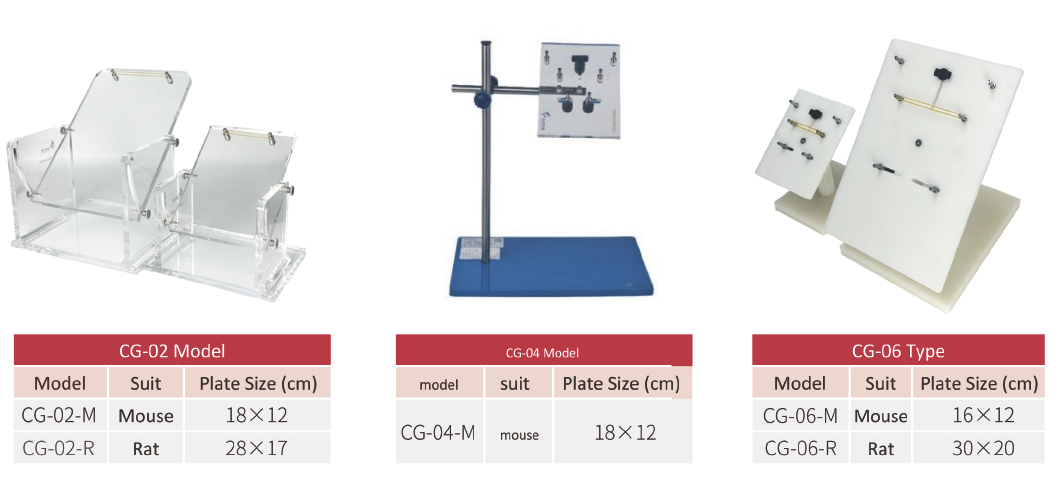
b. SR-309 Small Animal LaryngosUsed for observing structures such as the larynx in experimental animals, facilitating procedures like pulmonary drug administrationand transoral endotracheal intubation. Suitable for mice, rats, and guinea pigs, and can be customized according to specific requirements.
The LED lighting system provides clear and bright illumination, offeringimproved visibility for operators examining structures such as thelarynx and epiglottis. The front end features a stainless steel blade tipthat can be easily removed or replaced. The handle design adheres toergonomic principles, ensuring comfortable and convenient operation.
3. Dry Powder Insufflator---Operations of Dry Powder Insufflator
a. Set atomization gas volume
Twisting the gas supply injector into the one-way cyclone module, comfirm the connection is firm. At this time, the syringe can be pulled or push to set amount of air needed to be atomized.
b. Loading power
How to correctly load the Dry Powder Insufflator
1. Remove the air syringe from the Insufflator prior to loading and weighing it.
2. Before loading, weigh the device empty using a precision balance.
3. Determine the desired dose volume. Use a narrow spatula to place the dry powder dose intothe hole of the Sample Chamber.
4. It is best to simply let the powder fall from the spatula into the Sample Chamber. Take care not to jab or force the tip of the spatula too deeply into the Sample Chamber, as it may damage the valve assembly inside it.
5. NEVER load the gas supply injector portion of the device with powder, as this may interfere with the proper function of the Dry Powder Insufflator.
6. Once the powder is in the Sample Chamber, tap the chamber lightly to settle the sample
contents toward the distal tip.
7. Check to be sure that the connecting surfaces of the tapered joint are free of powder,
8. Re-attach the Sample Chamber to the gas supply injector by gently pushing the two halves together. When re-attaching the two halves, use only enough force to ensure that the connection between them will not separate when a puff of air is delivered. Pushing the two parts together forcefully may loosen some of the sample inside and force it out of the delivery tube. This is particularly of concern when using very small dose volumes. Do not overtighten
Attention: Single atomization powder mass: 1-10 mg(if the Sample density =1)
c. Connecting atomization transfer and one-way
twisted the one-way cyclone module into the atomization transfer module. It is suggested that the needle tip of the atomization transfer module be connected and used downward, so as to avoid pouring the sample into the cyclone module and increase the cleaning work.
d. Quantitative atomization
For intratracheal use, the placement of the very tip of the delivery tube is critical for obtaining the best results. In prior published studies, optimal lung deposition from intratracheal aerosol devices is obtained when the very tip is carefully positioned in the trachea so that the very tip is near to but not touching the carina (first ifurcation) of the anesthetized animal The device exerts a slight insufflating effect, and permits the user to administer a precisely measured dose of dry powder deep into the lung. In the process of quantitative atomization, remove a quantitative column adjacent to the handle of the high-pressure push device first, the faster the pressure is,the smaller the particle size of the atomization.
4. Dry Powder Insufflator--Attentions:
·The sample should be less than 100 micron dry powder sample.
·Pressing piston quickly to the end leads to a good atomization
·The gas supply injector could be replaced by the standard medical syringe .
·Atomization transfer module can be cleaned by ultrasonic, sterilized by high temperature and high pressure, and it can be disassembled into three parts: aerosol transfer needle, lock nut and atomizing chamber, so that it can be cleaned thoroughly
·One-way cyclone module can not be sterilized by high pressure and can not be cleaned with any organic solvent to avoid damage. Clean air is recommended to be blown into the insufflators from the end of the syringe. It would be better to use Cotton swabs to clean the visible chamber and exterior parts.


